
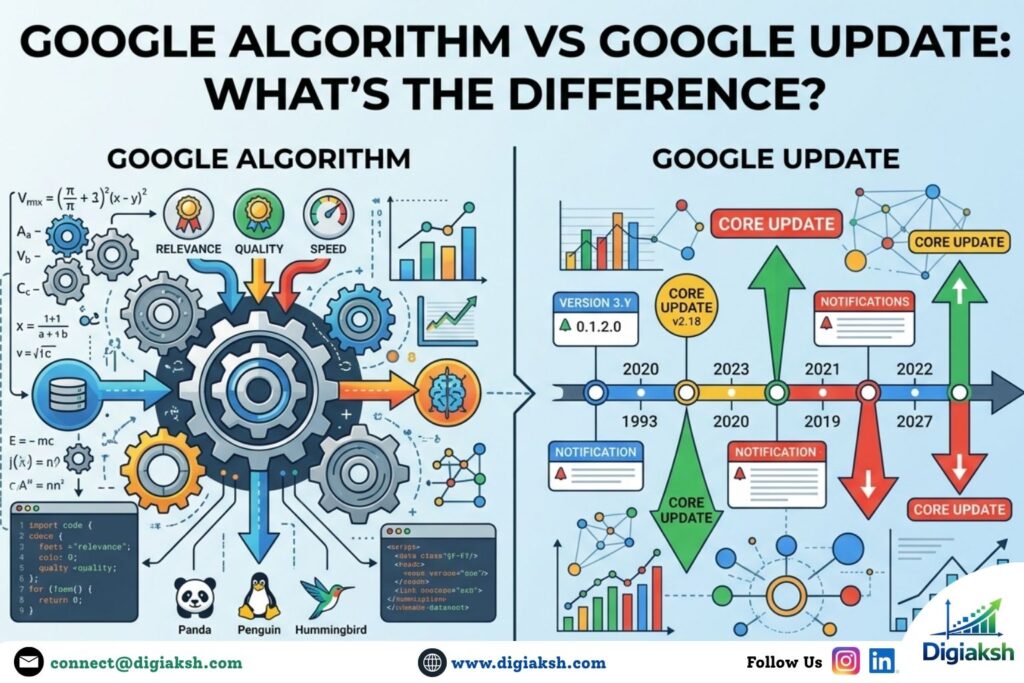
If you have ever seen your website rankings suddenly change, you may have heard people say that “Google changed its algorithm” or “Google released an update.” But are these two things the same? Understanding Google Algorithm vs Google Update is important for anyone working on SEO. While an algorithm refers to the systems Google uses to understand, evaluate, and rank information, an update is a change Google makes to those systems. Let’s break down the difference in simple terms.
What Is a Google Algorithm?
A Google algorithm is essentially a set of systems and processes that help Google understand search queries, evaluate web pages, and determine which results should appear for a particular search.
Google has billions of web pages to process, so it cannot simply match a keyword with a webpage and decide which result should rank first. Its search systems consider many signals and factors to understand relevance, quality, context, and other aspects of a page.
Over the years, Google has introduced several important named systems and algorithm changes, including Panda, Penguin, Hummingbird, RankBrain, and BERT.
- Panda focused on improving the handling of low-quality content.
- Penguin addressed manipulative link-building and webspam.
- Hummingbird improved Google’s ability to understand the meaning and context behind search queries.
- RankBrain introduced machine learning into Google’s understanding of queries and search results.
- BERT helped Google better understand the context and relationships between words in searches.
These names represent important stages in the development of Google Search. They should not necessarily be thought of as completely separate algorithms operating independently today, because Google has continued to integrate and evolve its search systems.
What Is a Google Update?
A Google update is a change, improvement, or adjustment to Google’s search systems. Google continuously works on improving Search, but some changes are significant enough to be announced or discussed publicly.
For example, Google core updates involve broad changes to Google’s core ranking systems. A website may gain or lose rankings following a core update because Google’s systems may evaluate content and other signals differently.
Google also releases spam updates, which focus on improving the detection and handling of spammy or manipulative content and practices.
Other documented update types have included Reviews updates, which focused on improving the way Google’s systems evaluate review-related content.
There have also been major changes to Google’s helpful-content systems. The helpful-content system was designed to reward content created primarily to help people rather than content created mainly to attract search traffic. Google later incorporated this system into its broader core ranking systems.
The important point is that an update is a change to Google’s search systems, rather than the search system itself.
Google Algorithm vs Google Update: What’s the Difference?
The easiest way to understand Google Algorithm vs Google Update is to think about a recipe.
The algorithm is the recipe, while an update is a change to that recipe.
For example, imagine a restaurant has a recipe for preparing a dish. The recipe provides instructions for how the dish should be prepared. If the chef changes the ingredients or cooking method to improve the dish, that is an update to the recipe.
Google Search works in a much more complex way, but the basic idea is similar.
| Google Algorithm | Google Update |
| A system or process used by Google Search | A change or improvement to Google’s systems |
| Helps Google process and rank information | Can change how certain systems evaluate information |
| Works as part of Google’s search infrastructure | Can be released to improve or modify Search |
| Examples include named systems such as Panda, Penguin and RankBrain | Examples include core and spam updates |
So, when someone says, “Google changed its algorithm”, they may be referring broadly to a change in Google’s ranking systems. When they say, “Google released an update”, they are usually referring to a specific change or rollout made to those systems.
What Are Google Core and Spam Updates?
Not every Google update has the same purpose.
Core updates are broad changes to Google’s core ranking systems. They can result in noticeable ranking changes across different websites, industries, queries, and types of content.
Spam updates, on the other hand, are focused on improving Google’s ability to detect and address spam. Websites using manipulative techniques may be affected when Google’s spam-detection systems improve.
This is why a ranking drop after an update does not automatically mean that a website has received a “penalty.” A change in rankings can happen because Google’s systems have changed how they evaluate different pages and content.
Is Google Discover a Google Update?
Google Discover is sometimes mentioned alongside Google Search, but it is important not to confuse the two.
Google Discover is a content-discovery surface, not a type of Google algorithm update. Unlike traditional Google Search, where users enter a query, Discover presents content based on users’ interests and other signals.
This distinction matters because visibility in Google Search and visibility in Discover can work differently. A website can focus on search optimization while also creating content that may be suitable for Discover, but the two should not be treated as identical systems.
How Do Google Updates Affect SEO?
Google updates can cause changes in organic search visibility. Some pages may gain rankings, while others may lose positions for particular queries.
However, not every ranking fluctuation means that Google has released an update.
Rankings can change because of competitors, changes in search intent, technical SEO problems, indexing issues, content changes, seasonality, SERP changes, or many other factors.
If your rankings change after a confirmed Google update, avoid making large changes immediately. Instead, compare your performance before and after the update, identify which pages and queries were affected, and review your content against the needs of your audience and search intent.
What Should You Do After a Google Update?
The best response to a Google update is to investigate rather than panic.
Start by checking whether Google has officially announced an update. Then review your organic traffic, rankings, affected pages, and search queries.
Look at your content quality, relevance, user experience, internal linking, technical SEO, and overall website structure. It is also useful to compare your pages with other results appearing for the same search queries.
Most importantly, avoid trying to guess one secret ranking factor behind every update. SEO is an ongoing process, and sustainable improvements generally come from building a website that provides useful, relevant, trustworthy information for its audience.
Conclusion
Understanding Google Algorithm vs Google Update makes it easier to interpret ranking changes and make better SEO decisions. An algorithm is part of the system Google uses to process and rank information, while an update is a change made to those systems.
If you want a data-driven approach to improving your website’s visibility on Google, Digiaksh Marketing Solutions can help you identify SEO opportunities, analyse ranking changes, and build a practical optimization strategy. Whether you are looking for an SEO Freelancer in Mumbai or ongoing SEO support, the focus should be on sustainable improvements rather than chasing every Google update.