
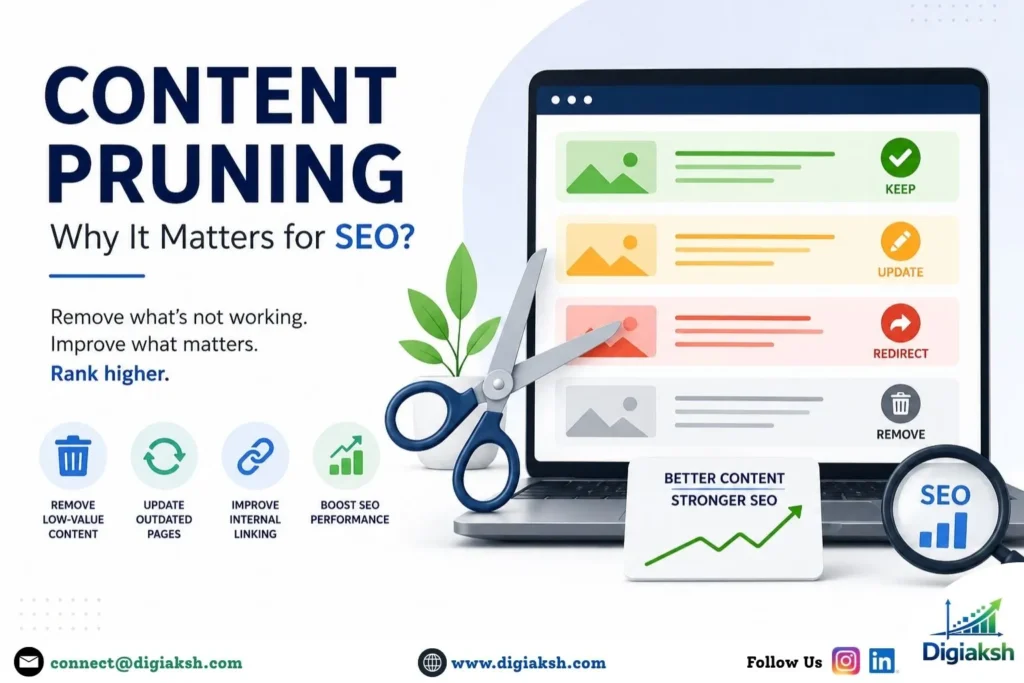
Publishing new content consistently is often seen as the key to growing organic traffic. But there is another side of search engine optimization that gets far less attention: removing content that no longer serves a purpose. Content Pruning is the process of reviewing, improving, consolidating, or removing outdated and low-value pages from a website. When done strategically, it can help search engines understand your website better while making the overall experience more useful for visitors.
What Is Content Pruning?
Content pruning is essentially a cleanup process for your website. Over time, websites accumulate old blog posts, outdated landing pages, duplicate articles, thin pages, expired offers, and content that simply doesn’t attract visitors anymore.
Instead of allowing all these pages to sit untouched, you evaluate their performance and decide what should happen to each one.
Some pages may need a complete rewrite. Others might be better combined with a stronger article. Some can be redirected to a more relevant page, while genuinely useless content may need to be removed.
The goal isn’t to delete content just because it isn’t ranking. The goal is to make sure that the content you keep provides genuine value.
Why Does Content Pruning Matter for SEO?
A large website isn’t automatically a better website. Search engines need to crawl, understand, and evaluate your pages. Having hundreds or thousands of weak, outdated, or repetitive pages can make it harder to maintain a clear and useful content structure.
This is where content pruning in SEO becomes valuable.
Regular pruning can help you:
- Remove outdated or inaccurate information
- Reduce unnecessary content duplication
- Strengthen your internal linking structure
- Improve the overall quality of your website
- Consolidate similar pages targeting the same topic
- Give more attention to pages with genuine search potential
It can also make your website easier for users to navigate. Nobody wants to land on an article containing information that was relevant five years ago but is no longer accurate.
Which Content Should You Prune?
One of the biggest mistakes businesses make is deleting pages simply because they don’t receive much traffic.
Low traffic alone doesn’t necessarily mean a page has no value. A page could have valuable backlinks, generate leads, rank for long-tail keywords, or support another important page through internal links.
Instead, look for patterns.
Content that deserves closer attention may include:
- Pages with consistently little or no organic traffic
- Articles containing outdated information
- Multiple pages covering almost identical topics
- Thin content that provides very little useful information
- Old service or product pages that are no longer relevant
- Pages receiving impressions but very few meaningful clicks
This evaluation should ideally be part of a broader SEO content audit, rather than a random deletion exercise.
How to Approach Content Pruning
A practical approach starts with collecting data. Look at organic traffic, keyword rankings, backlinks, conversions, impressions, and engagement metrics for your existing pages.
Then categorize your content into a few simple groups: keep, update, consolidate, redirect, or remove.
For example, imagine you have three blog posts targeting nearly the same search intent. Instead of allowing them to compete with each other, you could combine their strongest information into one comprehensive resource and redirect the weaker URLs to it.
Similarly, an old article with strong backlinks but outdated information may be worth updating rather than deleting.
This approach makes website content pruning much more strategic.
Content Pruning vs. Website Content Optimization
Content pruning and website content optimization are closely connected, but they aren’t exactly the same thing.
Pruning focuses on deciding what content deserves to remain on your website and what should be changed, combined, redirected, or removed.
Optimization focuses on improving the content you decide to keep. This might involve updating statistics, improving headings, answering search intent more effectively, adding internal links, improving readability, or strengthening on-page SEO.
In practice, the two work best together. There is little point in spending hours optimizing pages that no longer deserve a place on your website.
How a SEO Consultant Can Help
Content pruning can look simple from the outside, but deciding what to remove requires careful analysis. A page with zero traffic today could still have SEO value that isn’t immediately obvious.
An experienced SEO Consultant can evaluate your website using search performance, backlinks, rankings, content relevance, and user intent before recommending what should be changed or removed.
This is particularly useful for large websites where manually reviewing hundreds of URLs can become time-consuming.
Conclusion
Content Pruning is not about simply deleting old pages. It is about making your website more focused, useful, and aligned with what your audience and search engines actually need. By regularly reviewing outdated, duplicate, and underperforming content, businesses can create a stronger foundation for long-term Search Engine Optimization.
At Digiaksh Marketing Solutions, we believe effective SEO is about improving what already exists while creating content that has a clear purpose. A strategic content pruning process, combined with ongoing website content optimization, can help businesses build a healthier website and create better opportunities for sustainable organic growth.